Read concise summaries of the manufacturer’s published cases and application articles. The original case technology is identified; these are not presented as Connect Hive’s own projects.
Application insight
Separate room humidity from compressed-air dew point
The manufacturer distinguishes room humidity control from moisture control inside compressed-air systems. Environmental humidification addresses conditions in the space; air drying addresses the pressure dew point of air supplied to pneumatic equipment and piping.
APPLICATION IN CONTEXT
12345
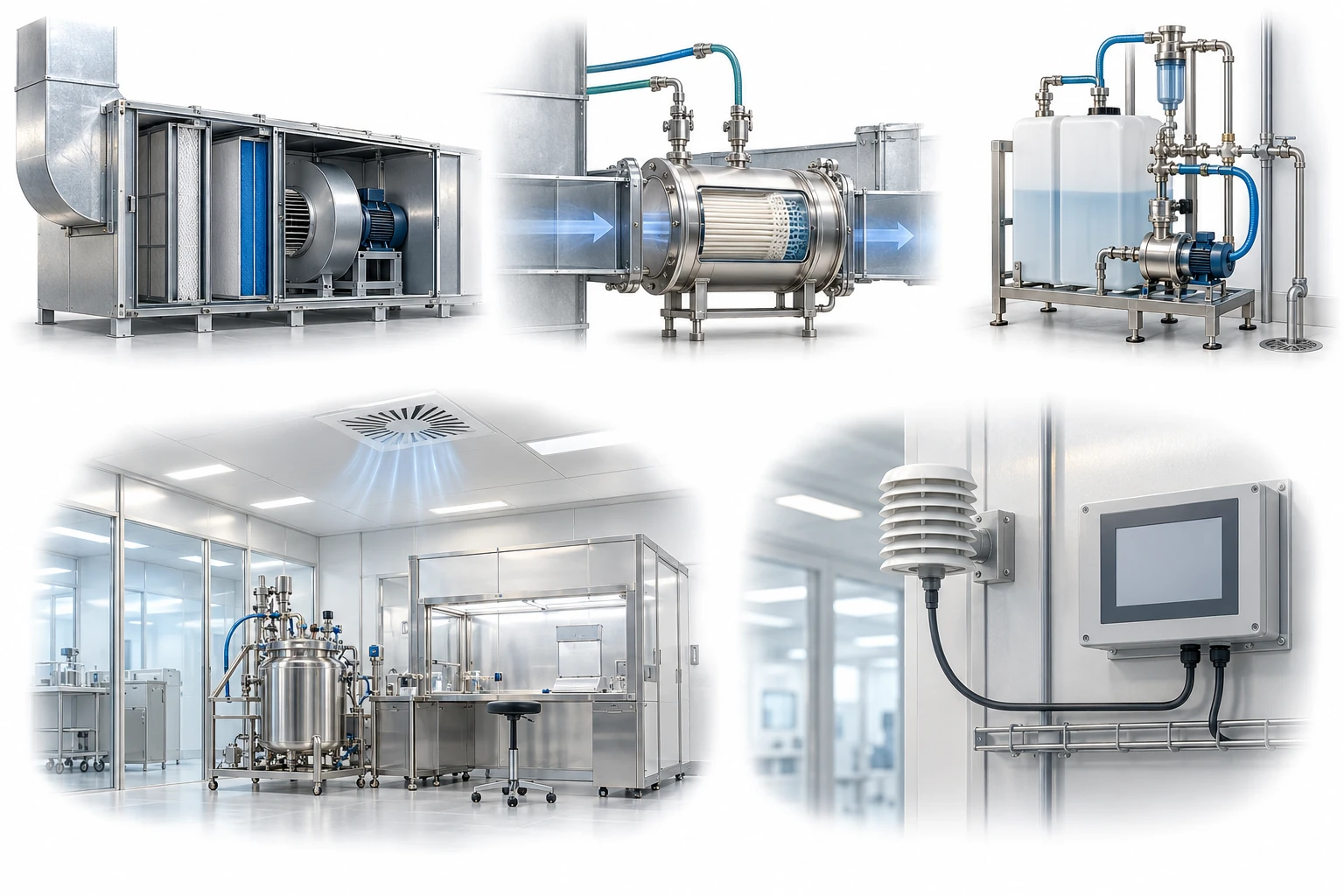
Separate room-humidity management through air handling from pressure-dew-point management at compressed-air use points.
01Ventilation and air handling
02Humidification moisture transfer
03Conditioned facility space
04Compressed-air drying
05Sensors and facility controls
Humidification transfers moisture; drying reduces it. Check the distinct roles and supply scope of particle/oil treatment and humidity/dew-point control.
A conceptual illustration created to explain equipment and application locations. It is not an actual product photograph, installation photograph or piping/wiring design.
What to review in your process
Measure room temperature and humidity separately from compressed-air pressure dew point, then compare cold-surface temperatures and target conditions.
Confirm model-specific operating conditions and the actual supply configuration. This insight summarizes manufacturer application guidance.
Environmental humidity in pharmaceutical manufacturing
The manufacturer discusses environmental humidity when handling moisture-sensitive materials and products in pharmaceutical facilities. Coating, filling and packaging may require different temperature and humidity conditions, which should be defined for each process.
APPLICATION IN CONTEXT
12345
A membrane humidification example separates water and air paths before conditioned air enters the controlled area, with temperature/humidity feedback and water management.
01Air-handler air
02Hollow-fiber humidification
03Water supply/circulation
04Controlled area
05Temperature/RH control
This is an illustrative HVAC integration for review. The module is not presented as a sterile barrier or a verified installed reference.
A conceptual illustration created to explain equipment and application locations. It is not an actual product photograph, installation photograph or piping/wiring design.
What to review in your process
Define material moisture sensitivity, process environmental limits, HVAC airflow and temperature, measurement locations and qualification scope first.
Manufacturer application commentary; not a Connect Hive installation or a guarantee of sterility, GMP compliance or airborne contaminant removal.
Temperature and humidity in semiconductor and electronics manufacturing
The manufacturer discusses static risks at low humidity and condensation or corrosion risks from excess moisture in semiconductor environments. Cleanroom and assembly-area conditions should be checked against the requirements of each process and facility.
APPLICATION IN CONTEXT
12345
Review room humidity, pneumatic moisture and water pretreatment around semiconductor and electronics equipment as separate duties.
01Production room and equipment
02Air handling and moisture transfer
03Pneumatic pretreatment and drying
04Water-pretreatment review
05Humidity and dew-point records
Environmental control and wetted process paths have different boundaries. Review the equipment and site requirements; this illustration does not establish cleanliness, yield or water purity.
A conceptual illustration created to explain equipment and application locations. It is not an actual product photograph, installation photograph or piping/wiring design.
What to review in your process
Review temperature and humidity together, including zone targets, sensor locations, HVAC loads and existing ESD controls.
Manufacturer application commentary, not a Connect Hive installation or a guarantee of air filtration, yield improvement or ESD prevention.
Humidity in food storage, aging rooms and smart farms
The manufacturer outlines humidity-control applications in food storage, aging rooms, greenhouses and vertical farms. Targets vary by stored product or crop, so temperature, airflow, moisture load and operating practices need to be reviewed together.
APPLICATION IN CONTEXT
12345
Locate humidification, ventilation and temperature/RH measurements in greenhouse/vertical-growing and post-harvest storage spaces.
01Greenhouse cultivation
02Vertical growing
03Post-harvest storage
04Humidification, ventilation and dehumidification review
05Temperature/RH and operating records
Humidity needs differ by crop, growth stage and stored commodity. Separate irrigation/nutrient liquid from air humidification and review condensation/excess-humidity risk.
A conceptual illustration created to explain equipment and application locations. It is not an actual product photograph, installation photograph or piping/wiring design.
What to review in your process
Identify the product or crop, environmental targets, ventilation, seasonal moisture loads and surfaces where condensation may occur.
Manufacturer application commentary, not a Connect Hive project or a guarantee of shelf life, crop yield or microbial control.
Paper moisture and environmental humidity in printing
The manufacturer describes how paper exchanges moisture with its surroundings, affecting dimensions, flatness and feeding. Reviewing conditions in both printing and paper-storage areas provides a useful starting point for humidity-control applications.
APPLICATION IN CONTEXT
12345
Show room humidity and equipment pneumatic supply separately around paper storage, feeding, printing and finishing.
01Paper storage and feeding
02Printing and transport
03Cutting, folding and packaging
04Room humidity and air handling
05Pneumatics and sensor records
Paper moisture equilibrium, static and dimensional change depend on the material and process. No universal humidity target or productivity improvement is implied.
A conceptual illustration created to explain equipment and application locations. It is not an actual product photograph, installation photograph or piping/wiring design.
What to review in your process
Review paper type, temperature and humidity changes between storage and production, static or feeding issues, and HVAC airflow.
Manufacturer application commentary, not a Connect Hive installation. Source environmental settings are not universal recommendations for every printing process.
Published reference: UF pretreatment for wafer wastewater reuse
A published Korean semiconductor reference describes wafer-process wastewater reuse through UF pretreatment followed by RO, EDI and polishing. The case considers fine-particle management together with limited installation space.
APPLICATION IN CONTEXT
12345
Show feed characterization/pretreatment, membrane separation and distinct permeate/concentrate handling paths for industrial-water recovery.
01Feed and equalization
02Pretreatment and solids reduction
03Membrane separation and concentration
04Permeate and duty-specific downstream treatment
05Concentrate recovery and handling
Select the membrane and downstream treatment for the feed chemistry. This typical arrangement does not establish an installation reference, water purity or reuse suitability.
A conceptual illustration created to explain equipment and application locations. It is not an actual product photograph, installation photograph or piping/wiring design.
What to review in your process
Review feed variability, pretreatment duties, downstream water-quality targets and installation space as one integrated process.
An external manufacturer’s industrial-water UF pretreatment reference. The conditions and results do not transfer automatically to another feed, membrane or process.
Published reference: RO module performance evaluation and replacement review
The manufacturer’s Daesan Industrial Water Center reference describes evaluating RO elements for permeate performance, salt rejection and fouling to inform replacement decisions. It also discusses UF pretreatment and compatibility with existing treatment equipment.
APPLICATION IN CONTEXT
A schematic of RO replacement-review inputs: operating records, permeate performance/salt rejection, fouling inspection and module-by-module comparison.
01Operating/cleaning records and feed
02RO element and test conditions
03Permeate flux and salt rejection
04Fouling, scaling and defect inspection
05Module comparison against baseline
The manufacturer’s reference describes removing RO elements for controlled-pressure flux and salt-rejection testing, inspecting fouling/scaling/defects and comparing performance with a baseline. Verify site results, test conditions and replacement decisions against the source and case-specific evidence. The diagram shows neither actual equipment nor numerical results.
An original explanatory schematic, not a product or installation photograph or a piping design.
What to review in your process
Prepare replacement decisions using operating records, comparison baselines, feed quality, cleaning history and defined test conditions for individual modules.
An external manufacturer’s RO evaluation reference. Results at that site do not establish the performance of another membrane or evaluation platform.