
Define the transfer purpose
Determine whether the operation is a single transfer, continuous supply, or recirculation.
Compare product damage, pulsation, residual volume, and cleaning conditions as well as flow rate and pressure.
Review selection pointsDiscuss this applicationReview product locations and fluid paths.
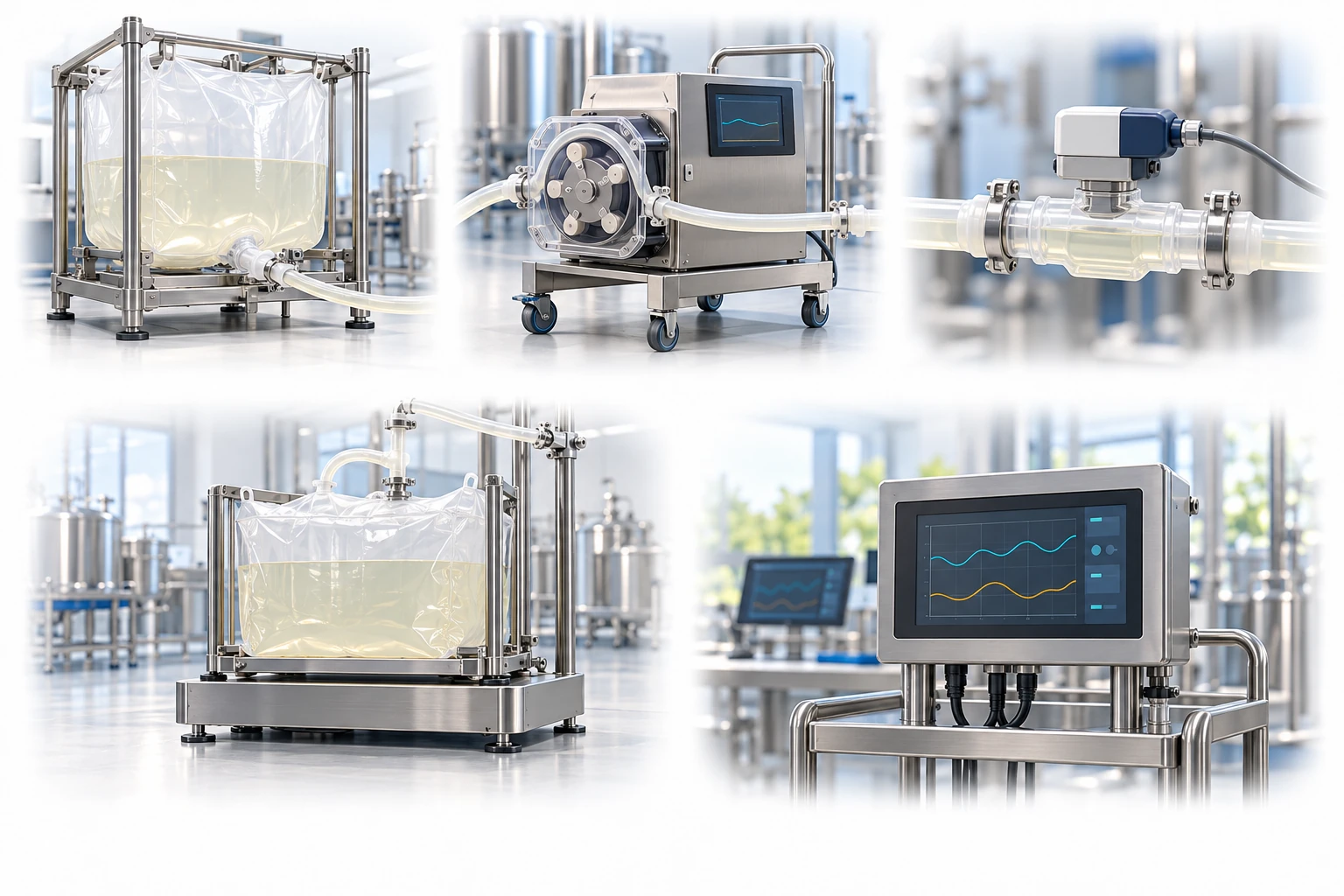
Evaluate pump tubing, connections and actual-fluid quality and recovery together.
A conceptual illustration created to explain equipment and application locations. It is not an actual product photograph, installation photograph or piping/wiring design.
Scroll horizontally to see the complete flow.
Select pump type according to viscosity, shear, bubbles, flow, and pressure. The diagram does not indicate the performance of a particular pump or suitability for every fluid.
These conceptual views explain flow direction. Actual piping, wiring and physical flow rates require a separate design.
Define the intended use and conditions to identify the required role of each item.
Determine whether the operation is a single transfer, continuous supply, or recirculation.
Check minimum/maximum flow rates, system pressure losses, and the control range.
Use the actual liquid to evaluate recovery, quality, flow stability, and operating time.
Media supply, harvest fluid transfer, TFF recirculation, and transfer before filling have different requirements. Evaluate each pump type using the actual liquid and piping, and review material, sterilization, and traceability documentation for wetted components.
Scroll horizontally to review all columns.
| Process objective | Step to review | Selection evidence |
|---|---|---|
| TFF recirculation | Recirculation flow and pressure control | Integration with TMP control, shear, temperature rise, and extended operation |
| Sensitive product transfer | Product quality | Cell viability, protein aggregation, vector activity, and bubbles |
| Precision supply | Flow stability | Pulsation, reproducibility at low flow, and sensor and control integration |
| Wetted component management | Reusable / replacement components | CIP/SIP or sterilization compatibility, E&L, and residual volume |
Compare actual operating conditions with supplier evidence and confirm the required performance and validation scope.
The operating point changes with tubing length and internal diameter, and differential pressure across valves and filters.
Do not judge by descriptions such as low shear alone. Check quality changes at the actual number of recirculation passes and operating time.
Include tubing and head replacement, cleaning, installation space, maintenance, and control integration.
The choice depends on the required flow rate and head, product sensitivity, pulsation, and the approach to managing wetted components. Narrow the candidates for each type using the process conditions.
Confirm that it can deliver the required flow under the piping pressure losses and actual viscosity. Stable control at the minimum flow is also important.
These details help narrow the configuration and the evidence to review.
May we use Google Analytics, Google Ads and ChatGPT Ads to measure visits and completed enquiries? Learn more