
Bag installation and raw-material addition
Check drive engagement and minimum working volume, then add water, powder and additive solutions in the defined order.
Bags for dissolving powders and preparing media and buffers. Identify conditions that provide effective mixing while protecting the product.
Review selection pointsDiscuss this applicationReview product locations and fluid paths.
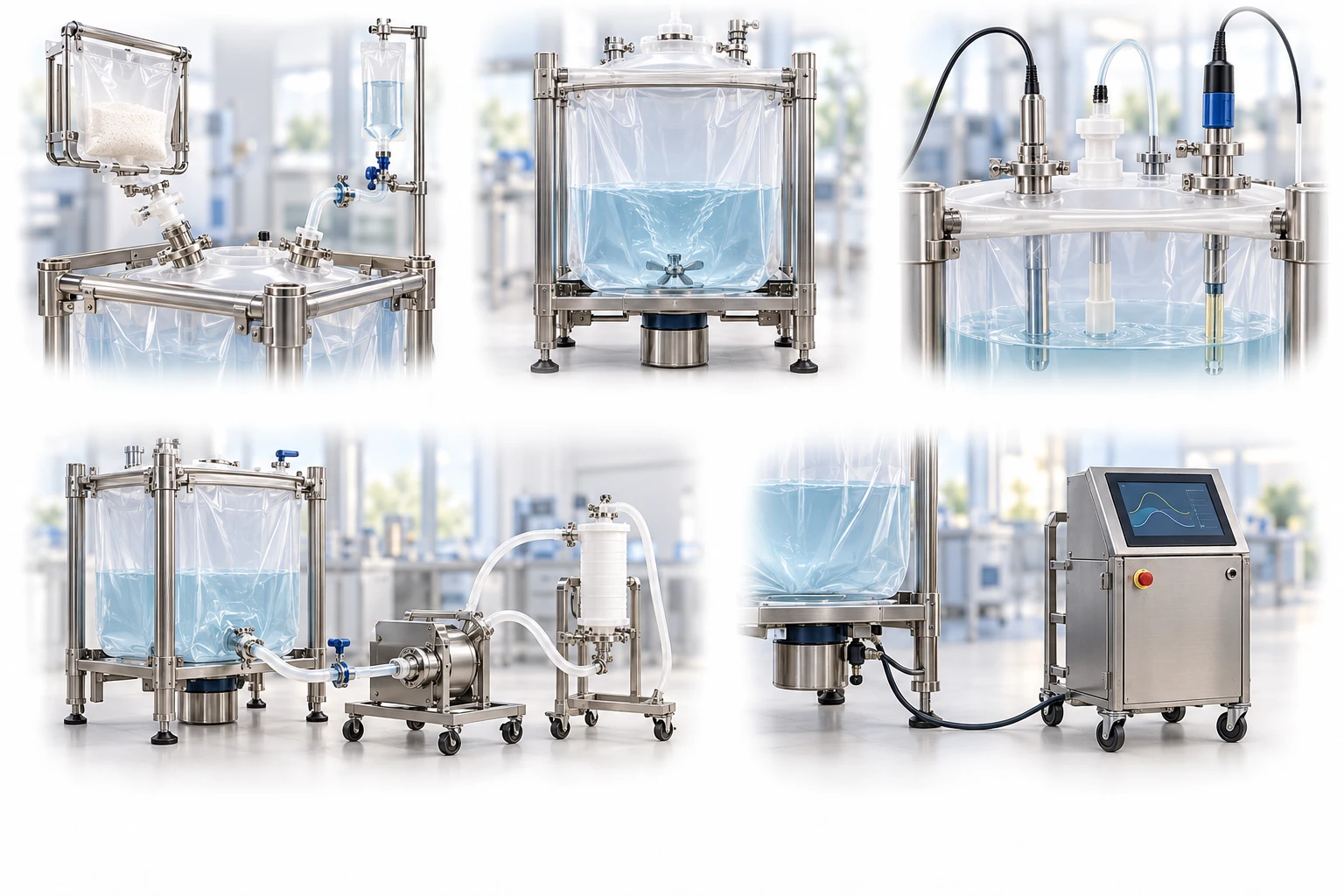
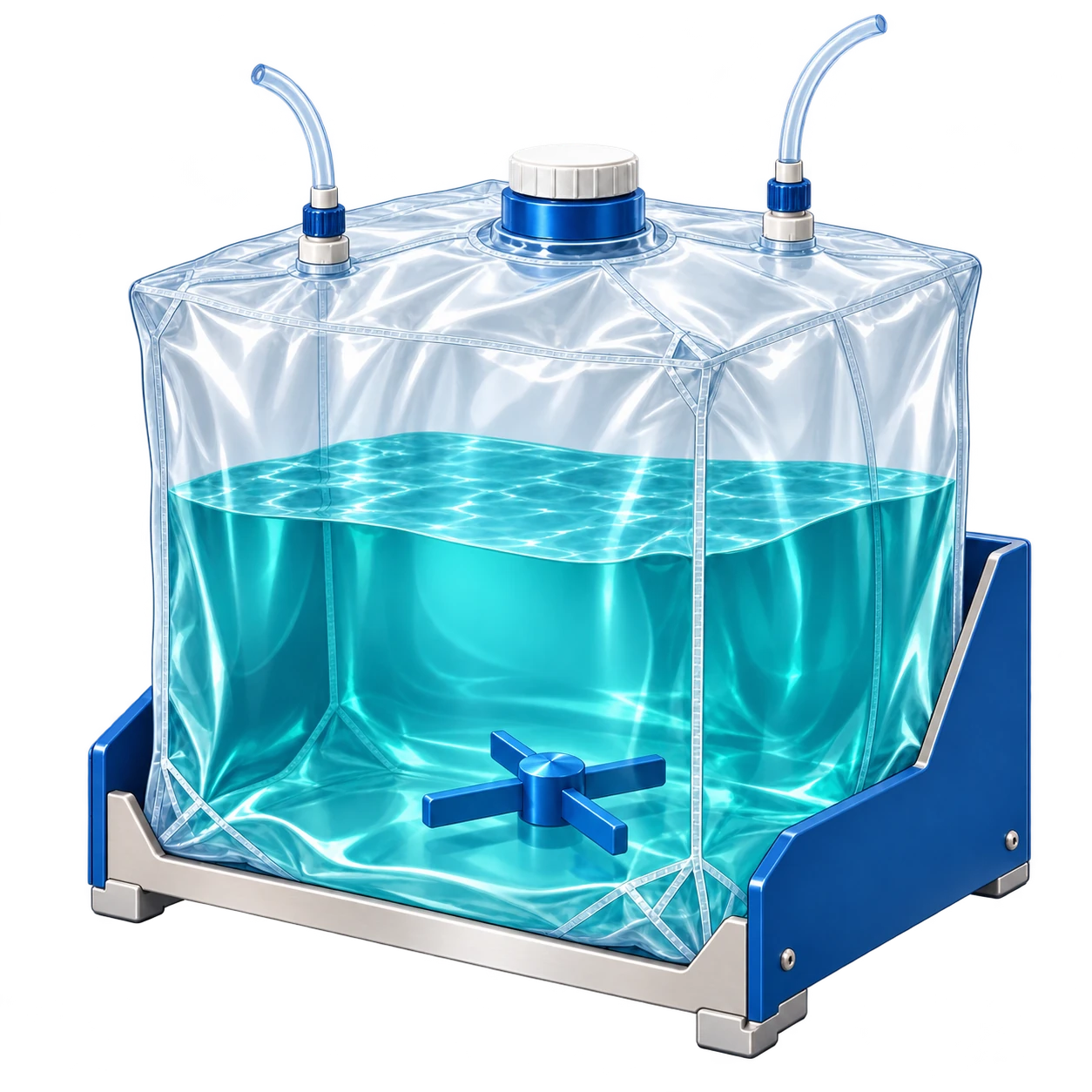
This example uses a magnetic-drive impeller. Minimum working volume and mixing performance are equipment- and fluid-specific.
A conceptual illustration created to explain equipment and application locations. It is not an actual product photograph, installation photograph or piping/wiring design.
Scroll horizontally to see the complete flow.
The diagram shows liquid movement and process order. During mixing, check conductivity, pH, undissolved particles, and, when needed, sample uniformity.
These conceptual views explain flow direction. Actual piping, wiring and physical flow rates require a separate design.
Define the intended use and conditions to identify the required role of each item.
Check drive engagement and minimum working volume, then add water, powder and additive solutions in the defined order.
Adjust rotational conditions and temperature while checking conductivity, pH, undissolved particles and uniformity at different locations.
Connect the required subsequent treatment or filtration, and check residual volume after draining, bubbles and product loss.
Mixing-bag performance depends on the combination of its dedicated impeller, drive and support container. First define the properties of the powders and fluids, actual working volume, addition sequence and criteria for complete mixing.
Scroll horizontally to review all columns.
| Bag or assembly function | Item to review | Selection evidence |
|---|---|---|
| Dissolve powder uniformly | Addition, wetting and dispersion | Powder properties, addition rate and sequence, concentration and mixing time |
| Match the equipment and bag | Impeller and drive | Equipment model, bag shape, magnetic coupling or drive mechanism |
| Operate from small to large volumes | Working volume range | Minimum fluid volume, liquid level, impeller submergence and testing at each scale |
| Determine when mixing is complete | Process sensors and samples | Conductivity, pH and temperature, uniformity across sample locations and undissolved particles |
| Protect sensitive proteins | Shear and bubble management | Mixing intensity, foam, changes in aggregation or activity, and recovery |
Volume or film name alone is insufficient. Review the actual fluid, contact conditions, equipment compatibility and supplier evidence.
Fine undissolved particles can remain even when conductivity has stabilized. Combine sampling appropriate to the actual formulation with checks of appearance and concentration.
Changes in scale, impeller geometry and liquid level change the flow pattern. Compare mixing time, uniformity and product quality at production scale.
Strong vortices and bubbles around sensors can affect readings. Review sensor location, mixing conditions and sample verification results together.
Do not add an arbitrary mixer to a standard storage bag. Review a mixing system designed for drive engagement, prevention of bag damage and maintenance of the sterile boundary.
Mixing and sterilizing filtration serve different purposes. Define filtration and any other required treatments separately according to the microbial requirements of the raw materials and subsequent process.
These details help narrow the configuration and the evidence to review.
This page explains selection considerations by application. It is not a commitment to supply every type, size or manufacturer’s product shown. Share the manufacturer and product code, or your configuration requirements, to discuss supply availability and outstanding checks.
Product-type and selection guide · Available configurations: confirm individually
Ask about supply for this configurationMay we use Google Analytics, Google Ads and ChatGPT Ads to measure visits and completed enquiries? Learn more