
Define the platform
Identify the target material and process stage for cells, antigens, vectors, nucleic acids, or LNPs.
Set recovery and activity criteria for each platform, and distinguish particle removal from product retention.
Review selection pointsDiscuss this applicationReview product locations and fluid paths.
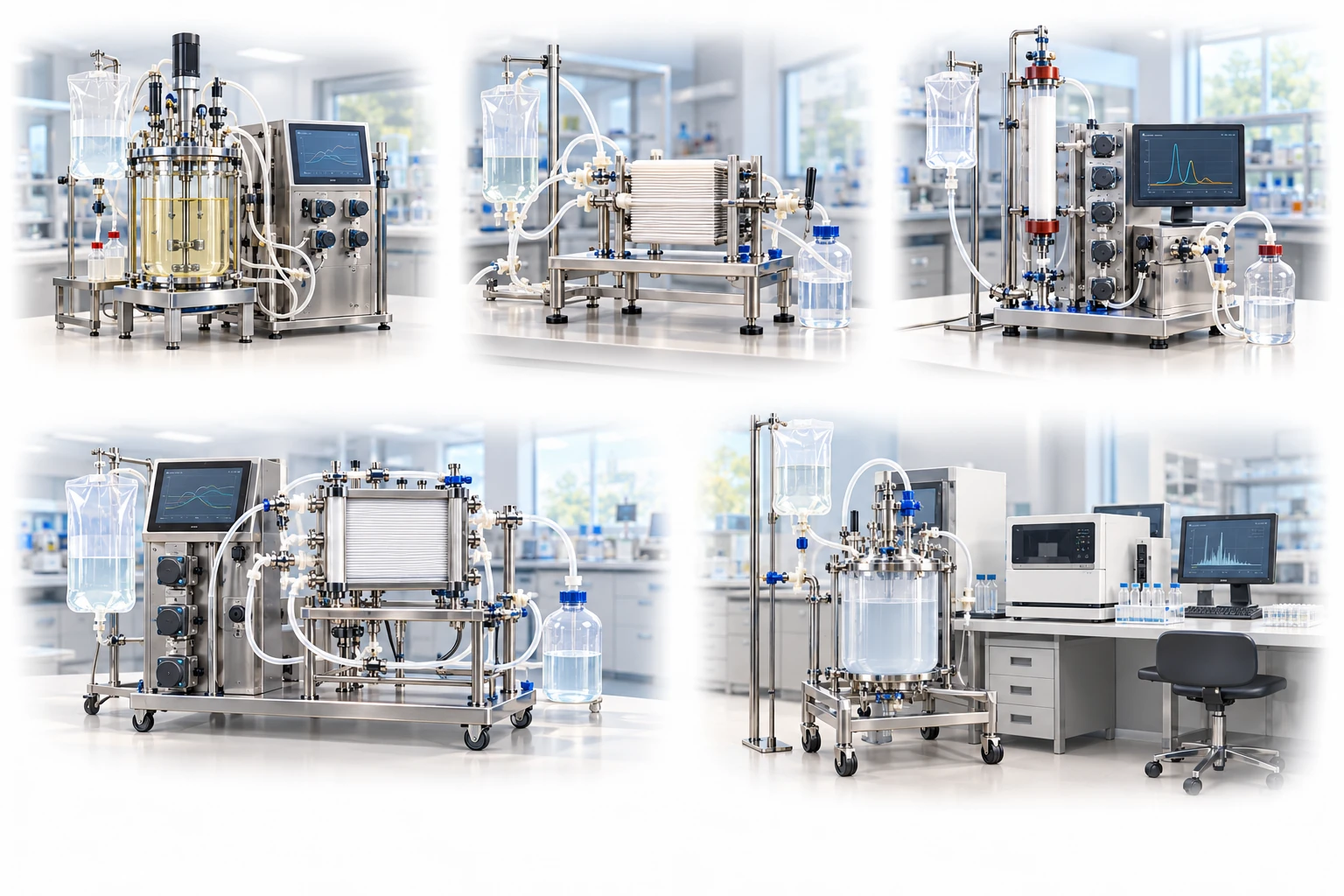
Dashed lines show platform-specific review relationships. Products do not all follow one serial process or use the same final filter.
A conceptual illustration created to explain equipment and application locations. It is not an actual product photograph, installation photograph or piping/wiring design.
Scroll horizontally to see the complete flow.
Examples of stages available for different platforms. Do not apply the same filtration sequence to every vaccine, vector, mRNA, LNP, or cell formulation. Feed may contain antigens, vectors, or nucleic acids; UF/DF concentrates product and exchanges buffer.
These conceptual views explain flow direction. Actual piping, wiring and physical flow rates require a separate design.
Define the intended use and conditions to identify the required role of each item.
Identify the target material and process stage for cells, antigens, vectors, nucleic acids, or LNPs.
Compare material balances, impurities, and activity losses at each step.
Check concentration, particle size and distribution, titer and function, and compatibility with the final process.
Vaccine antigens, AAV and lentivirus, mRNA, and LNPs present different separation challenges. Before using the same filter combinations across platforms, define which stream should contain the product and its activity and particle characteristics.
Scroll horizontally to review all columns.
| Process objective | Step to review | Selection evidence |
|---|---|---|
| Vaccine clarification | Platform-specific depth filtration | Antigen recovery, cell debris, and DNA/HCP |
| Viral vectors | Low-adsorption clarification / concentration | Physical titer, infectivity and activity, shear, and contact time |
| mRNA | Comparison of UF/DF conditions | Nucleic acid integrity, impurity and salt removal, and recovery |
| LNP and cell-containing formulations | Product-specific filterability assessment | Size, distribution, encapsulation efficiency, viability, and ability to pass through the membrane |
These examples start the application review. Pore size or nominal rating alone does not establish suitability or retention; confirm with the actual process fluid and supplier evidence.
Activity may change even when total particle count or nucleic acid quantity is maintained. Select quality tests suited to the platform.
For small-volume, high-value products, liquid remaining in the piping and adsorption losses can account for a substantial share of product losses.
Conduct scale-down tests before applying conditions that succeeded in antibody processes to vectors, mRNA, or cell products.
It may be unsuitable depending on product size and structure. Define a separate aseptic manufacturing strategy for each platform, including cell-containing products.
When the vector itself is the target product, do not confuse the virus to be removed with the product. First define the purpose and selectivity of the step.
These details help narrow the configuration and the evidence to review.
May we use Google Analytics, Google Ads and ChatGPT Ads to measure visits and completed enquiries? Learn more